Do they trust you?
Want to get a coder’s brain churning? Throw in a little game theory.
It must be the logic puzzle of it. One of the most famous is the Prisoner’s Dilemma:
You and a collaborator are being questioned separately about a crime. Each prisoner must choose whether to rat out the other or stay quiet. If you both stay quiet, you’ll receive a very light sentence. If you turn in a quiet partner, you go free, and they get the full sentence. If you both decide to rat out the other, you’ll receive the same modest sentence.
The best average outcome is to stay quiet. The best potential individual outcome is to be the only one who rats.
Whether you practice your canary calls and sing depends on how much you trust your collaborator.
It gets really interesting when you play multiple rounds with the same partner. There are academic papers and tournaments dedicated to strategies for this game—what signals make you trust someone and when do you turn on them?
There’s even an ongoing game developers can join by building an API to play the game:
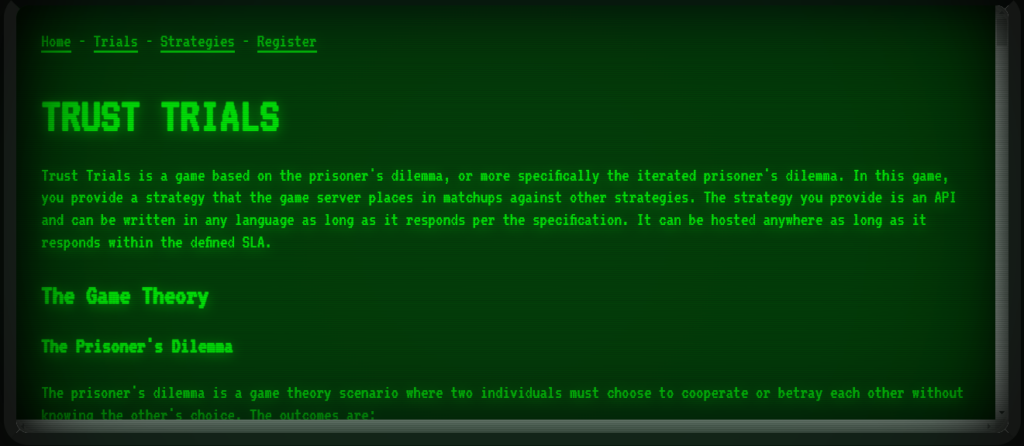
It’s called Trust Trials and it pairs up players every four hours. Each runs its own Prisoner’s Dilemma algorithm and receives points based on the outcome.
If only it were so easy to count the trust points you earn from developers.
But at least we know the sorts of things we can do to improve our score with the skeptical audience.
In fact, you can look at the 13 Developer Experience criteria as ways to build trust.
For example:
- Status pages show you intend to be transparent and accountable
- Prominent and complete docs communicate you value their time
- Every piece of technical content can be open knowledge sharing
Or all of these can send the opposite signal. And they’ll erode trust, or not build it in the first place.
You’re playing multiple rounds of this “game” with devs every day. Better use the strategy that builds trust.
Get your tool shortlisted
One short read a week you can use to better understand developers and the LLMs that drive their work.