Which Comparison Pages Do AI Models Actually Cite?
Right now, a developer is telling Codex, Cursor, or Claude Code to find a tool for their problem. If you market a dev tool, it could be yours they find. Or it might be your competitor. The difference may lie in the comparison pages the models find and cite when they search.
Marketers write comparison pages for buyers, but the models don't read them that way. I analyzed the comparison pages of 15 dev tools and the citations in 600 AI answers. Of the thousands of sources the models cited, 64% were pages the vendors don't control. The pages AI models cite aren't always the ones marketers expect, and most of them aren't on any product site.
This post covers your own pages first, then the pages you don't control. But first, some high-level analysis and more on how I gathered the data.
Do This Now: My Top Takeaways
I asked four AI models 30 questions about dev tools and tracked the 3,104 sources they cited. I'm about to dive into all of that data, but you might want to get straight to the point. Start with these actions, built from what I saw.
- Ask the AIs before you change anything. Run the comparison questions your buyers ask in the top models with search on and note what each one cites. ChatGPT sent 74% of its citations to the vendor's own site. Claude and Gemini flipped the script, preferring third-party sources over vendors.
- Make your pricing page quotable. State the facts, such as units, limits, and features, in plain text. Pricing pages were the most-referenced vendor page. Consider Pusher, which has no comparison pages at all, yet showed up in 30 answers via its pricing page.
- Go deep before you go broad. The models seem to reward depth, so improve existing pages before you add more. Typesense has a small number of robust comparison pages. They drew 62 citations across only nine pages.
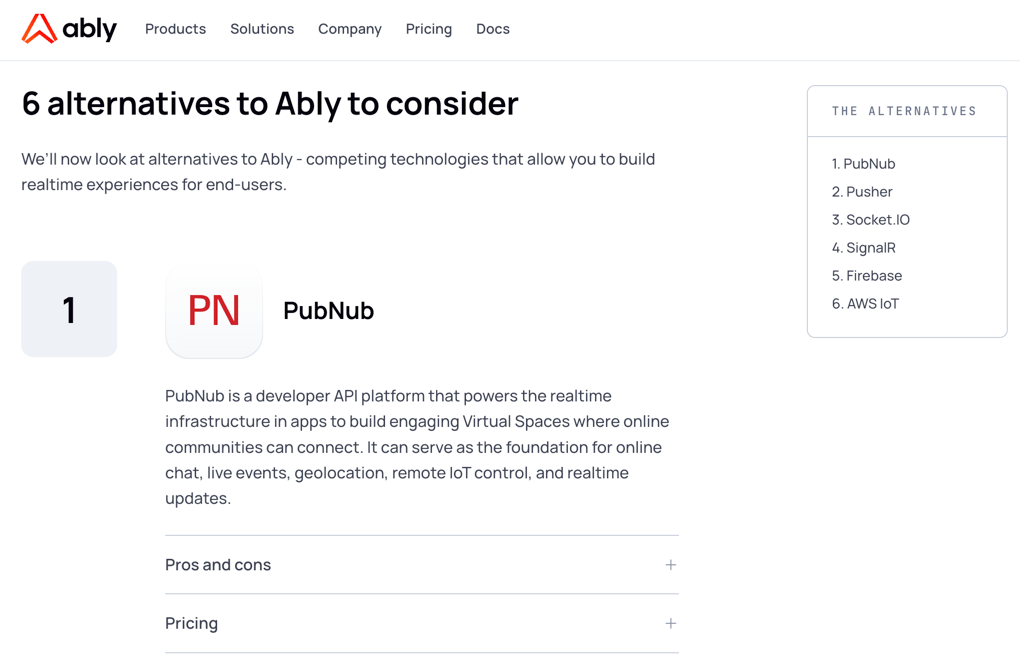
- Publish an honest "alternatives to [you]" page. It's a rare tactic, but seems like it's worth a try. Ably was the only leader with one and its own site came up in 13 of 20 answers about Ably alternatives.
- Send accurate facts to the pages you don't control. Find the third-party pages the models cite for your category and send their authors your current pricing, limits, and features. Nearly half of all citations (49%) went to neutral third-party pages.
- Read what your competitors say about you. Ask the models for alternatives to your product and read the competitor pages they cite. Other vendors made up 31% of citations on those questions.
How I Got These Numbers
I went in expecting comparison pages to dominate the citations. That's why I gathered every comparison page I could find for products in three dev tool categories (content management, search, and live data). In each category, I selected the top three products, as ranked by my tracker, llmrank.fyi, in October 2026, and called them the leaders. I then included two lower-ranked products as controls.
Next, I created 30 realistic developer prompts: category questions that name no company, alternatives questions, and head-to-head comparisons. I ran each prompt five times on four search-enabled models: GPT-6.1 Sol, Claude Opus 5.5, Gemini 3.1 Pro, and Gemini 4 Argon. That is 600 answers from November 2026. That's only 15 products in one snapshot, so it's hard to say these numbers hold up across an entire industry, but it gives us plenty of data to form hypotheses.
Make Your Site's Comparison Pages Worth Citing
Long before AI recommended its first dev tool, product marketers wrote comparison pages that read like battle cards, and SEO fueled entire sections of "alternative to" pages that often drew real traffic. You might not be able to see as much in your analytics today. The expectation now is that comparison pages will earn the citations when developers ask their agent for recommendations.
Partly, they do. Across 600 search-enabled answers from four AI models, own-site comparison pages (head-to-head, "alternatives," and listicle pages) were cited in 38% of answers. But the most-cited single vendor pages were pricing pages.
I audited every comparison page I could find across all 15 companies, then compared the nine leaders with the six controls. Here's what separates them:
- Leaders get their comparison pages cited more reliably. Seven of nine leaders had at least one of their own comparison pages cited, against three of six controls.
- Hubs show up with leaders. Six of nine leaders have a comparison hub, against one of six controls.
- Pricing pages pull their weight. All nine leaders had a pricing page cited, against four of six controls. Per company, leaders averaged about 18 pricing-page citations, more than 2x the controls.
Of the 3,104 sources, 1,110 were on sites the vendors own. Even category-level questions that named no company brought up an own-site comparison page in 20% of answers (24 of 120). And Ably, Meilisearch, and Typesense account for 272 of 367 own-site comparison page citations, nearly three in four.
The next four sections show that the pages that get cited aren't always the ones you'd expect.
Pricing Pages Do Comparison Work
Comparison pages usually live in one corner of a site, perhaps defined by a directory or hub page. I expected those to be the pages models cited. Instead, across all four models, the most-cited single vendor pages were pricing pages. Pusher shows how far this goes. I did not discover any comparison pages on its site, nor in the citations from the models. Yet its Channels pricing page showed up in 30 answers (the most of any product in this research).
This is half of the model split. The most likely model to reference a product's own website is GPT-6.1 Sol, which did so 74% of the time. Within those citations, half the time it's one of many docs pages and another 27% of the time it's pricing.
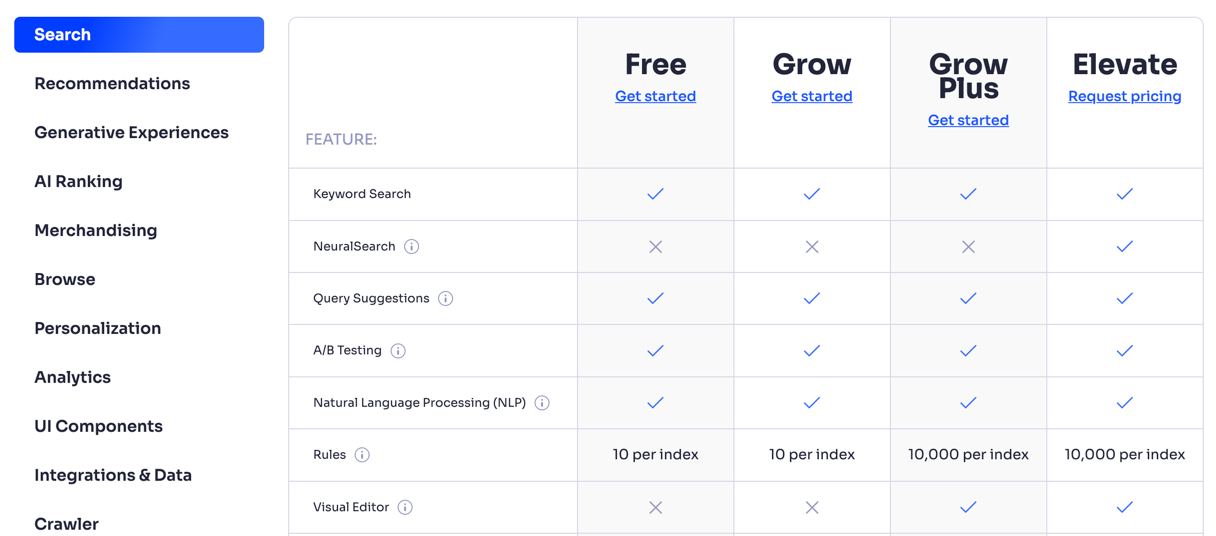
Algolia was a close second with 29 answers citing its pricing page. Like Pusher, Algolia charges based on volume, so there is data worth comparing in these pages. Algolia goes further, with a massive feature comparison table with more than 10 separate sections.
In my work with clients, I've seen the analytics for dozens of dev tools. Pricing pages are reliably popular with human visitors, often the highest-traffic page after the home page. It seems the models behind developers' agents are drawn to pricing, too.
Action: make pricing and limits pages answer the questions buyers ask (units, free tier, overage, hard limits) when comparing products, in plain text a model can quote.
Fewer, Deeper Head-to-Head Pages Win
I assumed the companies with the most comparison pages would get the most citations. They didn't. Sanity has 42 comparison pages and drew 22 citations. Algolia's 27 were referenced twice, both of its hub page. Ably has a shockingly large 700 comparison URLs (most of them programmatic pairs of other companies) and only 21 were cited at all.
This is the other half of the split: ChatGPT reads your pricing, while Claude and Gemini read your comparisons. When they cite a leader's own site, 62% to 94% of the time it's a comparison page. GPT-6.1 Sol almost never does (6%), because it leans on docs and pricing. What gets cited are the individual head-to-head pages, each one built around a single matchup.
Typesense only maintains nine comparison pages, but each is lengthy. The depth is likely what gets it 62 citations across those handful of pages. Cited in 16 answers, Typesense vs Elasticsearch is the clearest example. Rather than numbers or checkmarks, it favors paragraphs in its comparison tables. This gives LLMs a lot of chunky context to consider across six different areas: at-a-glance, setup, migration, cloud pricing, when to choose, and common questions. The "when Elasticsearch is a better fit" section is especially notable and is sure to build trust with developers and LLMs.
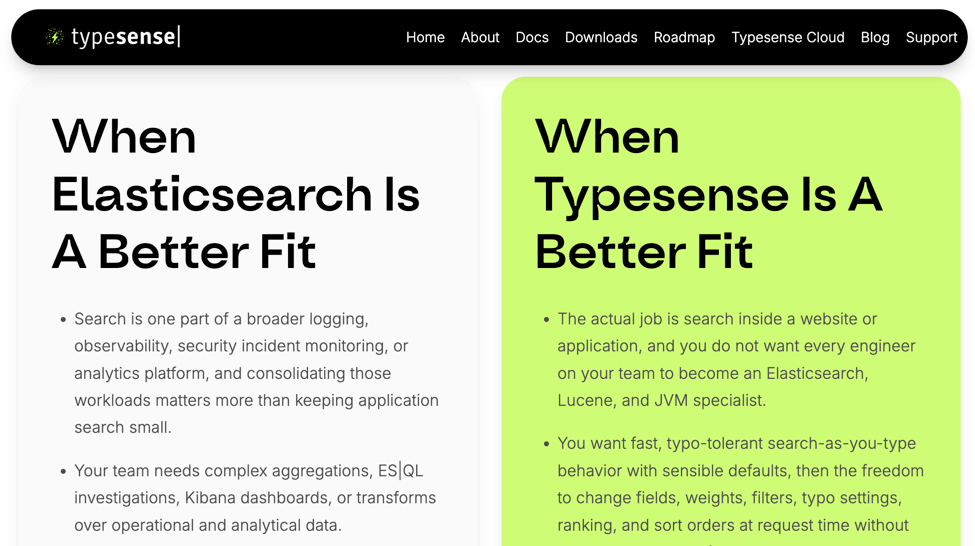
Meilisearch took a similar approach and turned it right back around on Typesense. Its Meilisearch vs Typesense page has multiple comparisons with headings for what Typesense does well and when to choose it.
Action: cover your real head-to-heads in depth, with "choose them if" guidance, before adding more pages.
An "Alternatives to [You]" Page Gets Cited
I thought alternative questions were unlikely to reference a product's own site. The user is asking about options beyond one brand, so why would the model cite that brand? One leader's page was cited anyway.
When the models were asked for the best alternatives to Ably, its own site appeared in 13 of 20 answers. For the other eight leaders, asked the same way, the most was six, and three were never cited.
The difference? Ably includes an alternatives page about its own product, and it was cited half of the time.
The only other example I found was Storyblok, which publishes a page for alternatives to itself. Unlike Ably, it names no rivals, so it doesn't look much like a true comparison. The headline, "there is no alternative to Storyblok," tells you everything you need to know about its point of view. That said, none of my prompts asked about alternatives to Storyblok, so I can't say how it would fare.
Ably and Storyblok were the only two of the 15 products I found with an alternatives page about themselves. This tactic appears underused for the impact it could have. But make it a real page, not a cheeky placeholder.
Action: publish an honest alternatives page for your own product, so the answers can draw from a source you wrote.
Most Leaders Have a Hub That Almost No One Cites
A hub is an index page, such as /compare, that links to all of a site's comparison pages. Six of nine leaders have one. Almost nobody cites it.
Products with a hub had their comparison pages cited more: a median of 22 citations, against 1 for those without one. Hub owners also tend to run bigger, better-maintained comparison programs, and most of them are leaders, so the data can't say the hub itself causes the citations. What's clear is that the hubs are rarely what gets cited: 10 citations in all, none from ChatGPT.
Typesense's hub drew five of those, Algolia's and Ably's two each, and Meilisearch's one. The other three were never cited.
Exceptions run both ways. Algolia has a hub, not linked from its navigation, and 27 comparison pages, yet only the hub was cited. Storyblok has no hub and drew 22 citations to its individual comparison pages.
So, a hub does not guarantee your pages will be cited, but it probably won't hurt. Plus, years of SEO guidance would suggest it's a good internal linking strategy. I'd still build one, mostly so visitors and crawlers can find the rest.
Action: if you publish several head-to-head pages, group them under a hub and link it from your navigation or footer.
The Comparisons You Don't Control
Everything above is on pages you write and publish. But the models don't stop at your site. They also cite comparisons written by competitors and third parties. You don't get to edit those, but you may still be able to have some influence.
Third-Party Coverage Tracks the Rankings
Most citations point to pages you don't own. That means other people's pages may shape your visibility more than your own do.
Eight out of nine leaders are named in more cited third-party pages than either control in its category. The exception is Elastic (#2), which is out-cited by Meilisearch (#4). To qualify, a product needs to be named in the URL or title.
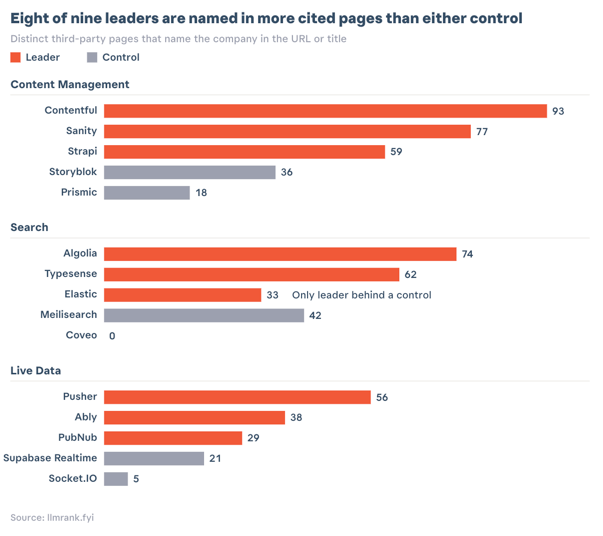
I could not find any comparison pages on Pusher's website, yet 56 third-party pages about it were cited 180 times. The most-cited is index.dev's Pusher vs Ably vs PubNub comparison, which appeared in 14 answers. Notably, the three products are an exact match for the top three, though it's hard to prove causation here.
Other categories had similar results. Two leaders, Algolia and Typesense, both get ranked near each other for search APIs. Recall that Algolia's own comparison pages earned no citations, while Typesense gathered many. Third-party citations correlate with ranking more closely than citations to a vendor's own site.
Content management is also cited in rank order, but be careful not to make too much of that. Contentful, the top-ranked product, is also one of the oldest. It had a four-year head start on second-place Sanity. But it's not that simple, either: Prismic was founded the same year as Contentful. Either way, the data can't show which causes which, but it does show where to look first.
Action: audit your own category, rather than assuming this data carries over. Ask the major models your buyers' questions, then list the third-party pages they cite.
You Can Reach the Writers Behind the Comparisons Models Cite
Someone wrote each of those third-party pages, and you can reach them. The authors I saw cited were mostly agencies and independent developers, not the vendors being compared. They're regular people you can contact without it getting awkward. You can't edit their pages, but you can make sure they have accurate facts about your pricing, limits, and features.
The most-cited third-party pages I found have some shared attributes:
- Most are recent, or at least include the year in the title
- They compare several vendors at once, and appear neutral
- Often they have details: specific prices, protocols, and limits
These are factors to include in your own comparisons, but they're also signs of a page that needs to be updated often. That's good news for you, if you hope to get your company added or represented accurately on someone else's page.
The pages in this study came from four kinds of publishers. Each has its own way in:
| Publisher type | Cited example | How to reach them |
|---|---|---|
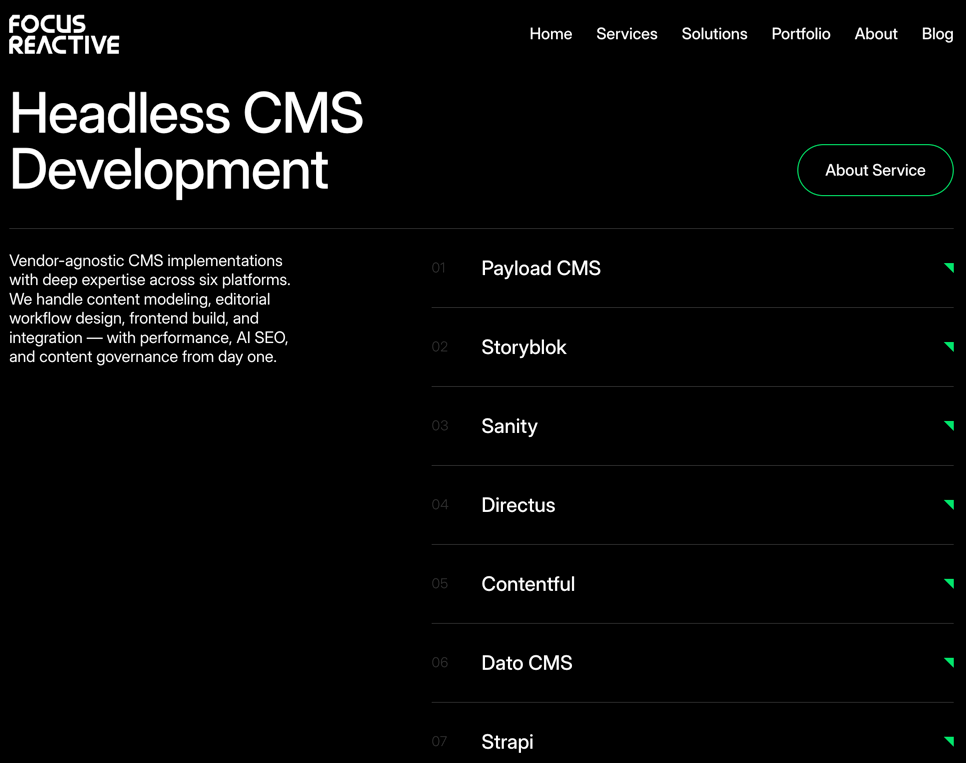
| Specialized developer agencies | Focus Reactive and its headless CMS comparison | You can usually find the individual who wrote the comparison. They're often close to client integrations, so they can recommend your product directly. |
| Dev tool directories | APIScout and its search comparison | Directories won't always show the people behind the site (the example is written by "APIScout Team"), but they usually have a way to suggest updates to a listing. |
| News and journals | TechInsider | Use the byline and datestamp. Come with facts and proof. These aren't always updated frequently, but you can ask about their editorial calendar. Many have an annual schedule. |
| Individual developers | Dev.to, with 46 citations, among the most-referenced domains | Most write about products they're trying out, and are open about how to reach them. |
Agencies show how this plays out. Focus Reactive's headless CMS comparison is a natural way to show off its expertise, and it was cited 15 times.
Action: start with the authors of the pages from your audit. Ask when they next update the page, and send each of them accurate pricing, limits, and features so that update gets you right.
Competitors Show Up as Alternatives to Your Product
When I worked for SendGrid, Mailchimp's competing product, Mandrill, had its own website for transactional email. Though I can't find an archive, I remember the alternative copy being on Mandrill's homepage. Like Mailchimp's existing comparison, it was blatantly one-sided. With such a direct shot at us on a prominent page, the marketing team successfully campaigned for the competitor to correct a couple of misrepresented facts.
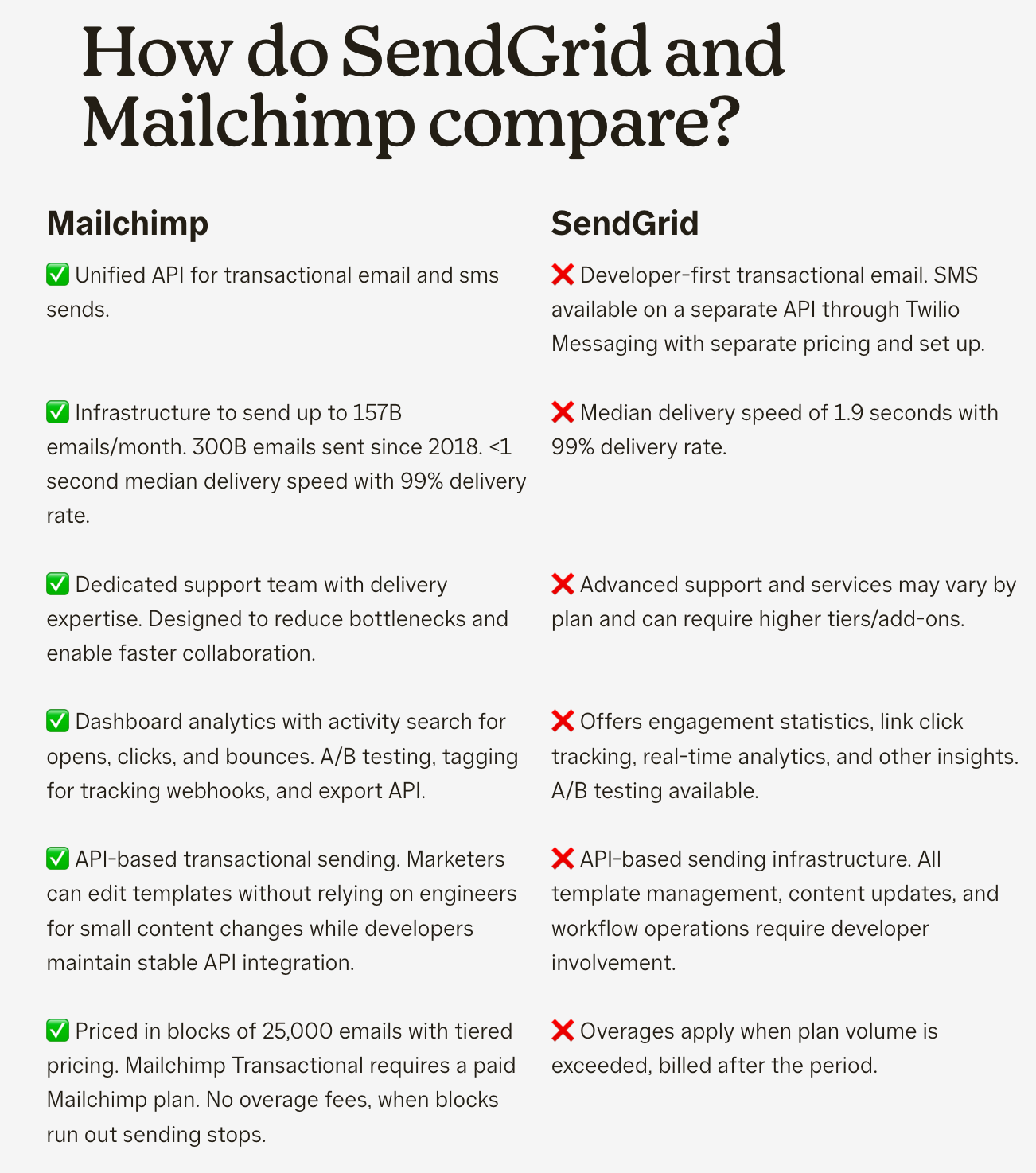
Not every comparison that influences your category comes from a neutral writer. Some come from the vendors you compete with, and they're written for your buyers. In this research, the clearest example was "alternative" pages, which were cited mostly in searches where developers name a specific product.
Other vendor sites account for 15% of all citations and 31% of the citations on "alternatives to X" questions. Almost half of the other-vendor citations on those questions (141 of 303) are alternatives pages and listicles that smaller vendors aim at the leaders.
In content management, I especially saw these aimed at Sanity and Strapi:
- Hygraph's "Sanity alternative" and "Strapi alternative" posts
- ElmapiCMS's "Sanity alternative" page
- UnfoldCMS's "Best Strapi alternatives 2026"
This works for the smaller vendor because they can't win the generic comparison. Instead, the page borrows the leader's name recognition, since developers search by that name. Some developers will already be familiar with the top tools and have reasons not to use them. They'll ask agents what else is out there, so that's a spot where you can show what you've got.
Your competitors will be writing these pages, too. And the tactic can be scaled to any number of other products. I found 67 alternatives pages on the sites of 8 of the 15 vendors in my research. Nine of the pages were cited by LLMs, showing up in 52 answers.
You have two responses to a competitor's alternatives pages:
- Publish your own alternatives pages, as covered earlier in this post, so your point of view has a chance to be included in responses
- Carefully influence the pages of your competitors, but only for egregious mistakes
The second response is like what my colleagues did at SendGrid. When you ask a competitor for changes, the request has to be strictly factual: a wrong price, a limit that has since changed, or a feature you do have. It will be awkward, because you're asking a rival to fix a page that could be working for them.
It's usually not worth your angst to worry or complain about competitor pages. It's better to spend your energy positioning your product in the direction of the right developers. But in the case of egregious inaccuracies, especially with proof that AI models are repeating them as fact, a polite ask may be your best move.
Action: search "alternatives to [your product]" in the major models and log every factual error in the competitor pages they cite.
The Shortlist Gets Built Before Anyone Visits Your Site
The developer hands the question to an agent, and the agent builds the shortlist before anyone visits your site. The pages it cites aren't the ones marketers expect, and most of them aren't yours. Your own pages matter, but not always the ones you'd expect, and pricing, depth, and honesty beat volume. Most of what agents read sits outside your control, so accurate facts on other sites matter as much as your own pages.
I'm tracking how it happens, one study at a time. I share much of my research and two decades of experience with developer audiences in Shortlisted, my weekly memo on how developers and their agents choose dev tools. I'd be remiss in my own marketing if I didn't leave you with one final action.
Action: Subscribe to Shortlisted to learn how your dev tool gets discovered and chosen
Get your tool shortlisted
One short read a week you can use to better understand developers and the LLMs that drive their work.